
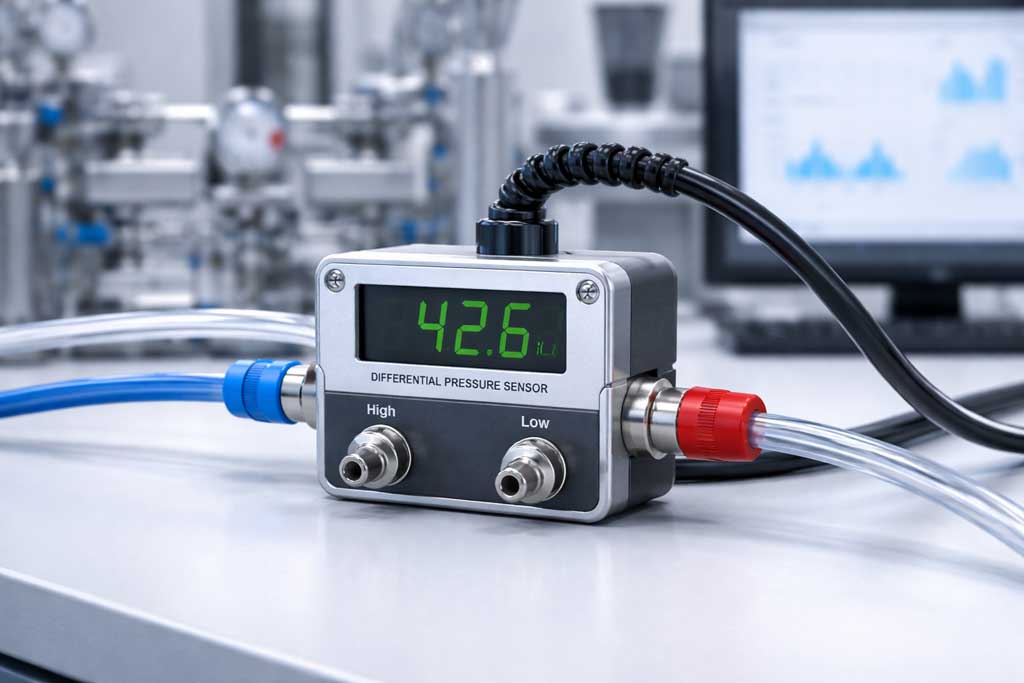
Efficient process control relies on accurate measurement — and few parameters are more critical than pressure. Whether managing gas flow in a chemical plant or monitoring fluid levels in a power generation system, stable pressure readings ensure operational safety, consistency and performance. One essential measurement technique at the heart of these systems is differential pressure monitoring, a principle that underpins a huge range of industrial applications.
In most systems, differential pressure sensor technology is used to measure the difference between two pressure inputs. This difference provides valuable information about flow rate, level, and filtration conditions inside closed-loop processes. By converting that pressure difference into a readable electrical output, engineers can monitor equipment performance and trigger automated adjustments through a control system or PLC network.
How Differential Pressure Measurement Works
A differential pressure sensor contains two pressure ports — typically labelled high (H) and low (L). These connect to different points in a system, such as upstream and downstream sides of a filter or flow restriction. The device measures the difference between these two pressures, rather than absolute or gauge pressure, offering extremely precise process feedback.
This principle is especially useful in applications such as:
- Flow measurement across orifice plates, venturi tubes, and pitot tubes.
- Filter monitoring in HVAC, pharmaceutical and chemical systems.
- Level measurement in pressurised tanks and vessels.
In these environments, a differential pressure transmitter takes the sensor signal and converts it into a proportional analog or digital output. Common formats include 4–20 mA, 1–5 V, or fieldbus protocols such as HART, Profibus or Modbus. The signal is linear to the pressure difference, allowing operators to observe trends or trigger alarms when thresholds are reached.
Sensor versus Transducer versus Transmitter – What’s the Difference?
While the terms are often used interchangeably, there are important distinctions between a differential pressure transducer, a sensor, and a transmitter.
- Sensor: The sensing element itself, which detects pressure changes and converts them into a raw electrical signal.
- Transducer: A complete device that converts that physical signal (pressure) into an electrical one — often in millivolts or volts.
- Transmitter: A development of the transducer that adds signal conditioning and amplification, typically producing a 4–20 mA current output or digital communications suitable for industrial control networks.
Choosing between them depends on system requirements. If the pressure data needs to be transmitted over long distances, a transmitter is preferred for its noise immunity and standardised output. For compact systems or data acquisition setups near the measurement point, a transducer or sensor may suffice.
Comparing Industrial Pressure Transmitter Technologies
In modern instrumentation, industrial pressure transmitters come in diverse types, suited to different operating conditions. Critical selection factors include pressure range, media compatibility, output type, and accuracy tolerance. Below are the most common core technologies:
- Capacitive transmitters: Extremely sensitive, ideal for low-pressure ranges and precise control.
- Piezoresistive (strain gauge) transmitters: Reliable across medium and high-pressure applications, offering robust mechanical design.
- Resonant silicon transmitters: Used when high accuracy and stability over temperature are key, such as in aerospace and scientific testing.
- Electromagnetic and optical variations: Found in specialist high-temperature or corrosive environments.
Choosing the right technology not only improves measurement accuracy but reduces drift and maintenance over the device’s life cycle.
Understanding Output Types: 4–20 mA, Voltage and Digital Communication
The way a transmitter communicates pressure data is fundamental to system integration and reliability.
- 4–20 mA analog signals are the industrial standard, providing noise-resistant communication over long cable runs. The current loop ensures that even with voltage losses or electrical interference, the signal remains accurate.
- Voltage outputs (1–5 V or 0–10 V) are suitable for short distances or laboratory applications.
- Digital outputs using HART, Modbus or CAN protocols allow for multidirectional communication — enabling both real-time measurement and configuration commands through the same wiring.
When replacing legacy equipment, matching output type and wiring configuration ensures compatibility with existing SCADA or distributed control systems (DCS).
Key Benefits of Differential Pressure Monitoring in Process Control
Differential pressure instrumentation remains an industry standard because it blends simplicity with versatility. Among its benefits:
- Monitors filtration efficiency by comparing upstream and downstream pressures.
- Measures flow rate using Bernoulli’s principle when combined with orifice plates.
- Detects blockages or leaks early in process pipelines.
- Determines liquid levels in sealed tanks by balancing hydrostatic pressure.
For engineers, this flexibility translates into better diagnostics, higher process uptime and reduced unplanned maintenance.
Integrating Industrial Pressure Sensors into Modern Systems
High-performance industrial pressure sensors are designed to integrate smoothly with data acquisition modules, PLCs and distributed control systems. Stainless steel housing, robust diaphragms and high ingress protection ratings make them suitable for aggressive media, vibration or outdoor exposure.
Applications range from energy production and water treatment to chemical manufacturing and food processing. Modular configuration options — pressure range, electrical output, and process connection — make it possible to tailor devices for almost any environment.
Calibration, Maintenance and Accuracy Considerations
Even the most precise sensor requires proper calibration to perform accurately over time. Calibration compares the device reading to a known standard under controlled conditions, allowing fine-tuning of the offset and span.
Routine maintenance checks should cover:
- Clean port connections to prevent blockage or condensation.
- Verifying integrity of housing seals to protect electronics.
- Checking for zero drift or signal noise over extended operation.
Periodic recalibration (typically every 6–12 months) ensures compliance with quality and safety standards across regulated industries such as pharmaceuticals, oil and gas, and power generation.
How to Select the Right Differential Pressure Device
To identify the most suitable product for your application, engineers should evaluate:
- Pressure range: Select a device that covers your expected differential range with a safety margin of around 25–50%.
- Media type: Confirm compatibility between the sensing diaphragm and process fluid to avoid corrosion or contamination.
- Environmental conditions: Temperature, vibration, moisture and electromagnetic fields can influence performance.
- Signal output: Match transmitter output with your existing control system input (analog or digital).
- Mounting and access: Consider whether inline, remote or panel mounting best fits your process design.
Proper selection ensures reliable data collection and efficient system control — avoiding costly downtime or inaccurate readings.
Supporting Measurement with Trusted Instrumentation Partners
For applications where reliability is non-negotiable, working with an instrumentation specialist can make all the difference. The StrainSense team offers a full portfolio of precision pressure measurement solutions, from compact transducers to rugged field-mount transmitters tested for industrial reliability.
Explore the full range of industrial pressure sensors options as well as advanced industrial-grade pressure transmitters and instrumentation components for every sector.
For even broader system integration, their range of pressure transmitters, differential pressure transducers, and industrial pressure transmitters includes both analog and digital models suitable for automation, R&D, and process plant operation. Each device is engineered for long-term stability and traceable accuracy — ensuring consistent performance in the most demanding conditions.
Featured image credit: AI generated.